
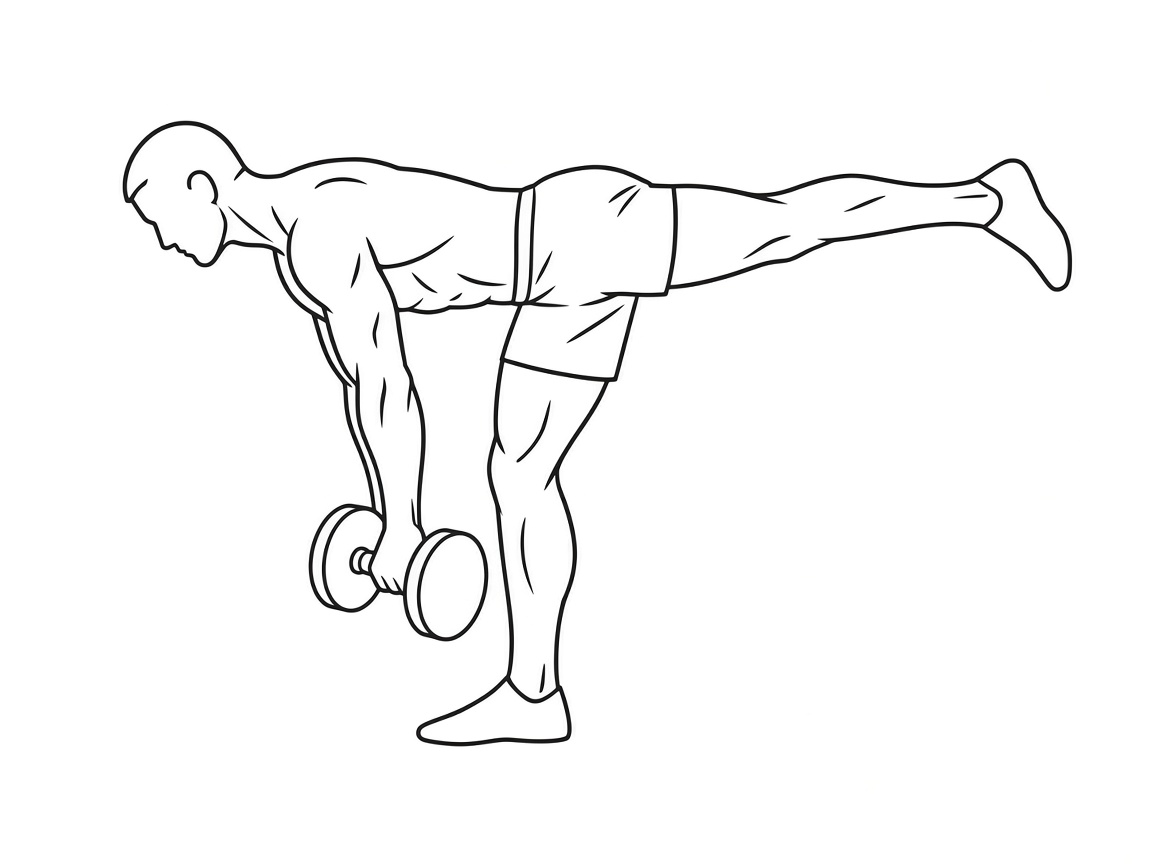
The single-leg deadlift, also called a single-leg stiff-leg deadlift, is hinging the torso forward on one supporting leg, while the other goes back. It is like a Romanian deadlift, only one leg at a time.
Besides the glutes and the back of the thigh, it trains balance. Start with no weight and hold a wall if you need to.
Quick summary
- Muscles: glutes and hamstrings, with plenty of work from the gluteus medius for balance
- Level: intermediate
- Equipment: one dumbbell (or none, to learn the movement)
How to do the single-leg deadlift
- Stand on one leg, with the supporting knee slightly bent. If you use a dumbbell, hold it in the opposite hand.
- Hinge the torso forward and send the free leg back, in line with the torso.
- Lower until your body is close to parallel with the floor, or as far as you can go without losing posture.
- Keep the hips level, without rotating to the side.
- Return to standing by squeezing the glute of the supporting leg. Finish one side, then switch.
Common mistakes
- The hip rotating. Both sides of the hip stay facing the floor.
- The back rounding. Lower only as far as the back stays straight.
- A locked supporting knee. It stays slightly bent.
- Rushing. Slowly, the balance comes faster.
Variations
Easier
With no weight, one hand on a wall or a sturdy chair.
Standard
With a dumbbell in the hand opposite the supporting leg.
Harder
A heavier dumbbell, or a dumbbell in each hand.
What the studies show
In a study with 21 healthy, active people, the single-leg deadlift activated the gluteus medius and the gluteus maximus in a similar way to the single-leg squat, and activated the gluteus maximus more than exercises such as the lateral band walk (Distefano and colleagues, 2009).
Sets to start with
For beginners, the American College of Sports Medicine position stand suggests a load that allows 8 to 12 reps, 2 to 3 times a week. When you can do 1 or 2 more reps than planned, increase the load a little: the document talks about 2% to 10% (ACSM, 2009).
In practice, 2 to 3 sets with 1 to 2 minutes of rest are a good starting point. That number of sets is a practical suggestion, not a rule.
Who should be careful
Anyone with dizziness, a balance problem, lower-back pain or a recent hamstring injury should start with a support and, if possible, with guidance from a physical therapist or certified trainer. Sharp pain is a signal to stop.
Informational text. It doesn’t replace an assessment by a certified trainer, physical therapist or doctor.
Read also
- Glute bridge: how to do it at home and progress to the hip thrust
- Lunge: how to do stationary, reverse and walking lunges
- Training: exercises, home gear and books
Where to go next
Glute training pays off more when food and sleep are in order. See building muscle.
References
- Distefano LJ et al. Gluteal muscle activation during common therapeutic exercises. J Orthop Sports Phys Ther. 2009;39(7):532-40. https://pubmed.ncbi.nlm.nih.gov/19574661/
- American College of Sports Medicine. American College of Sports Medicine position stand. Progression models in resistance training for healthy adults. Med Sci Sports Exerc. 2009;41(3):687-708. https://pubmed.ncbi.nlm.nih.gov/19204579/