
The bench press is the best-known chest exercise in the gym. You lie on the bench, lower the bar to your chest and press it back up. It looks simple, and it is, as long as the body stays planted on the bench and the load goes up little by little.
If you train at home and do not have a bench or a bar, the push-up does a similar job. Further down is what the research says about that.
Quick summary
- Muscles: chest, triceps and the front of the shoulder
- Level: beginner to intermediate (with a light load at first)
- Equipment: a barbell, plates and a flat bench with uprights

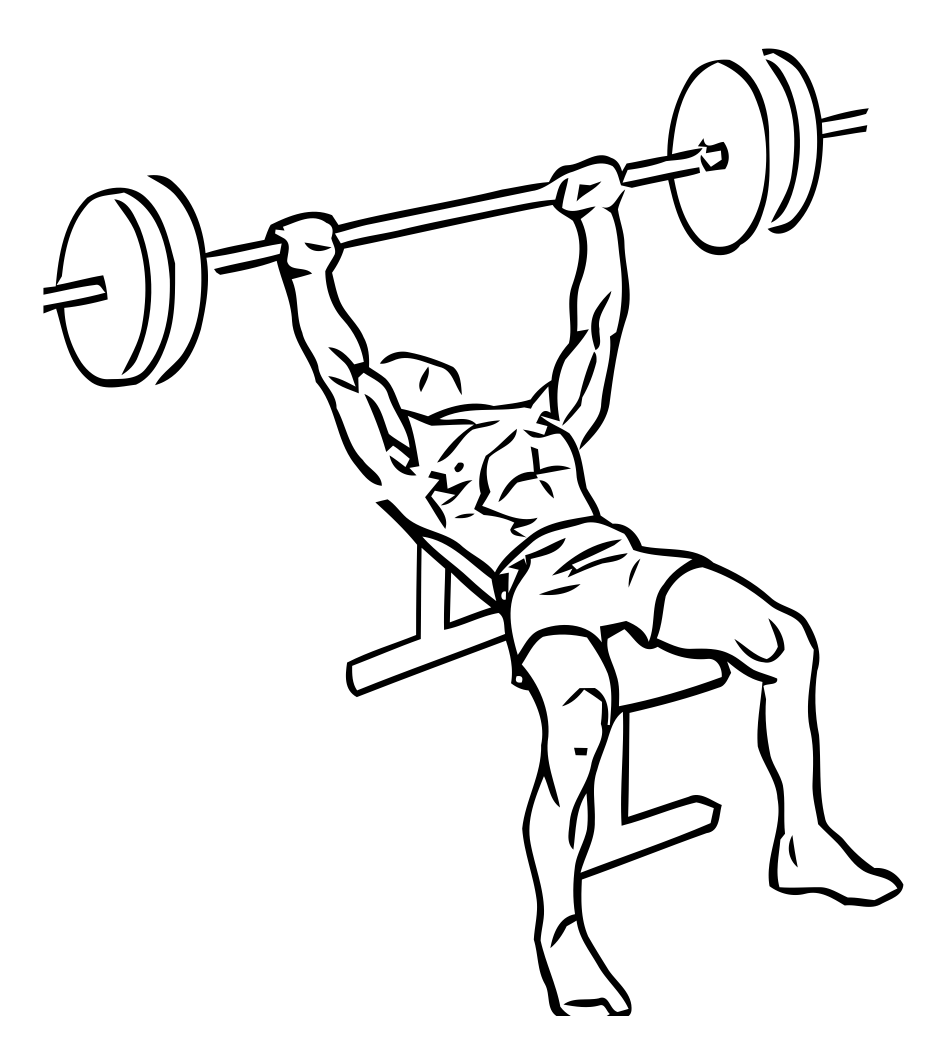
How to do the bench press
- Lie on the bench with your eyes roughly under the bar and your feet planted on the floor.
- Hold the bar with your hands a little wider than shoulder-width, wrists straight.
- Bring your shoulder blades together, as if you were tucking them into a back pocket, and keep your hips on the bench.
- Unrack the bar and bring it over the chest, with your arms straight.
- Lower under control until the bar lightly touches the mid-chest.
- Press back up until your arms are straight, breathing out on the way up.
When you train heavy, use the rack safety bars or ask someone to stand behind you. Alone and without a safety, stick to loads you are sure you can lift.
Common mistakes
- The hips coming off the bench. The hips stay down the whole time. If they rise, the load is too heavy.
- The bar bouncing off the chest. Touch lightly and press. The bounce takes control away from the movement.
- The wrist bending back. The bar sits on top of the wrist, in line with the forearm.
- Loose shoulders. Without the shoulder blades packed, the shoulder has no support and the bar wobbles.
Variations
Easier
A light dumbbell press, or an incline push-up with your hands on a sturdy bench.
Standard
A barbell bench press, with a load that allows clean reps.
Harder
A pause of one or two seconds with the bar on the chest, or an incline press to put more focus on the upper chest.
What the studies show
In a study with 30 trained adults, the bench press with a flat bench (0 degrees) was the one that most activated the mid and lower chest. The upper chest responded more with the bench at 30 degrees (Rodríguez-Ridao and colleagues, 2020).
In another study, college students with lifting experience trained for 5 weeks with the bench press or with a band-resisted push-up, at a similar intensity. Both groups gained strength in a similar way (Calatayud and colleagues, 2015). Anyone who trains at home can use a more resisted push-up in place of the bench press.
Sets to start with
For beginners, the American College of Sports Medicine position stand suggests a load that allows 8 to 12 reps, 2 to 3 times a week. When you can do 1 or 2 more reps than planned, increase the load a little: the document talks about 2% to 10% (ACSM, 2009).
In practice, 2 to 3 sets with 1 to 2 minutes of rest are a good starting point. That number of sets is a practical suggestion, not a rule.
Who should be careful
Anyone with pain in the shoulder, elbow or wrist should see a physical therapist or certified trainer before adding load. Uncontrolled high blood pressure and heart problems call for medical clearance before heavy strength training. Sharp pain, a stabbing pain or a locking sensation is a signal to stop.
Informational text. It doesn’t replace an assessment by a certified trainer, physical therapist or doctor.
Read also
- Push-up: how to do it, adapt it and progress
- Plank: how long to hold it and how to do it
- Training: exercises, home gear and books
Where to go next
The bench press helps build the chest and arms, but growth also depends on food and rest. The building muscle guide explains the rest of the picture. If you are in your first months at the gym, see what to take (and what not to).
References
- Rodríguez-Ridao D et al. Effect of Five Bench Inclinations on the Electromyographic Activity of the Pectoralis Major, Anterior Deltoid, and Triceps Brachii during the Bench Press Exercise. Int J Environ Res Public Health. 2020;17(19). https://pubmed.ncbi.nlm.nih.gov/33049982/
- Calatayud J et al. Bench press and push-up at comparable levels of muscle activity results in similar strength gains. J Strength Cond Res. 2015;29(1):246-53. https://pubmed.ncbi.nlm.nih.gov/24983847/
- American College of Sports Medicine. American College of Sports Medicine position stand. Progression models in resistance training for healthy adults. Med Sci Sports Exerc. 2009;41(3):687-708. https://pubmed.ncbi.nlm.nih.gov/19204579/
Image credits
- Everkinetic 0042 (bench-press) illustration, by Greg Priday / Everkinetic project — https://github.com/everkinetic/data — CC BY-SA 4.0. Used without changes.