
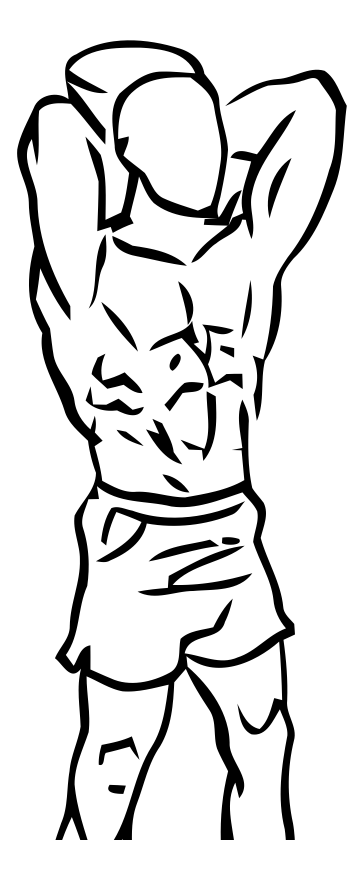
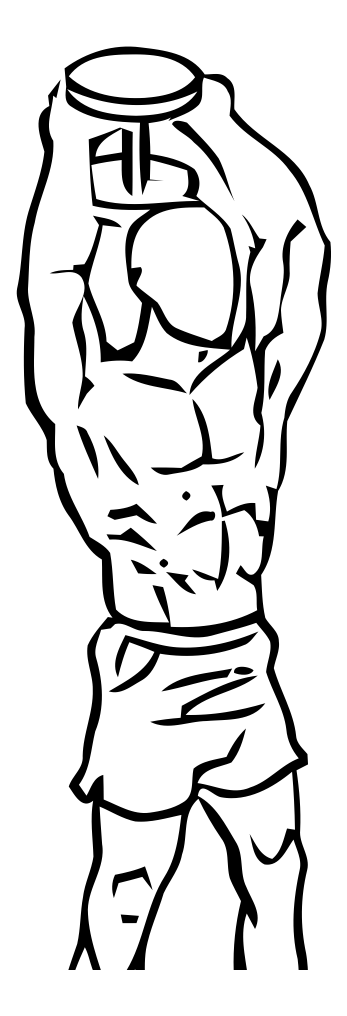
In the overhead triceps extension you hold a dumbbell above your head and bend the elbow, lowering the weight behind the neck. Then you straighten the arm again.
With the arm overhead, the triceps works in a more stretched position, and the research shows that this helps it grow.
Quick summary
- Muscles: triceps (the back of the arm)
- Level: beginner
- Equipment: one dumbbell
How to do the overhead triceps extension
- Stand with your feet shoulder-width apart, and hold a dumbbell with both hands around the top end.
- Bring the dumbbell above your head, arms extended and elbows pointing forward.
- Bend your elbows and lower the dumbbell behind your head, under control.
- Straighten your elbows and return to the top position.
Seated on a bench with a backrest, it is easier not to arch the lower back. With one arm at a time, use a lighter dumbbell.
Common mistakes
- The elbows flaring out too much. They point forward, close to the head.
- Arching the lower back. Brace the abs. If you arch, reduce the weight or do it seated.
- Lowering quickly. The dumbbell passes close to the head. Control the lowering phase.
- Moving the whole arm. Only the elbow bends. The upper arm stays still.
Variations
Easier
Seated, with your back supported and a light dumbbell.
Standard
Standing, with both hands on the same dumbbell.
Harder
With one arm at a time, or a cable extension with the arm overhead.
What the studies show
In a 12-week study with 21 adults, an elbow extension with the arm overhead made the triceps grow about 1.4 to 1.5 times more than the same extension with the arm by the side, even with a lighter load (Maeo and colleagues, 2023). The study used a cable, not a dumbbell, but the arm position is the same as in the overhead triceps extension.
Sets to start with
For beginners, the American College of Sports Medicine position stand suggests a load that allows 8 to 12 reps, 2 to 3 times a week. When you can do 1 or 2 more reps than planned, increase the load a little: the document talks about 2% to 10% (ACSM, 2009).
In practice, 2 to 3 sets with 1 to 2 minutes of rest are a good starting point. That number of sets is a practical suggestion, not a rule.
Who should be careful
Elbow or shoulder pain with the arm overhead calls for less load and an assessment by a physical therapist. Anyone with a recent shoulder injury should come back with guidance. Sharp pain is a signal to stop.
Informational text. It doesn’t replace an assessment by a certified trainer, physical therapist or doctor.
Read also
Where to go next
For the arm to grow, the training has to come with food and sleep: see building muscle.
References
- Maeo S et al. Triceps brachii hypertrophy is substantially greater after elbow extension training performed in the overhead versus neutral arm position. Eur J Sport Sci. 2023;23(7):1240-1250. https://pubmed.ncbi.nlm.nih.gov/35819335/
- American College of Sports Medicine. American College of Sports Medicine position stand. Progression models in resistance training for healthy adults. Med Sci Sports Exerc. 2009;41(3):687-708. https://pubmed.ncbi.nlm.nih.gov/19204579/
Image credits
- Everkinetic 0198 (standing-triceps-extension-2) illustration, by Greg Priday / Everkinetic project — https://github.com/everkinetic/data — CC BY-SA 4.0. Used without changes.