
The deadlift is picking a barbell up off the floor and standing up with it. It is a movement we do all the time, like lifting a heavy box, only with technique and a controlled load.
It works a lot of things at once, which is why it is tiring. It is also the exercise where rushing gets in the way the most: learn with a light weight and add load slowly.
Quick summary
- Muscles: back (spinal erectors), thighs, glutes and hamstrings; the grip works the forearm
- Level: intermediate
- Equipment: a barbell and plates
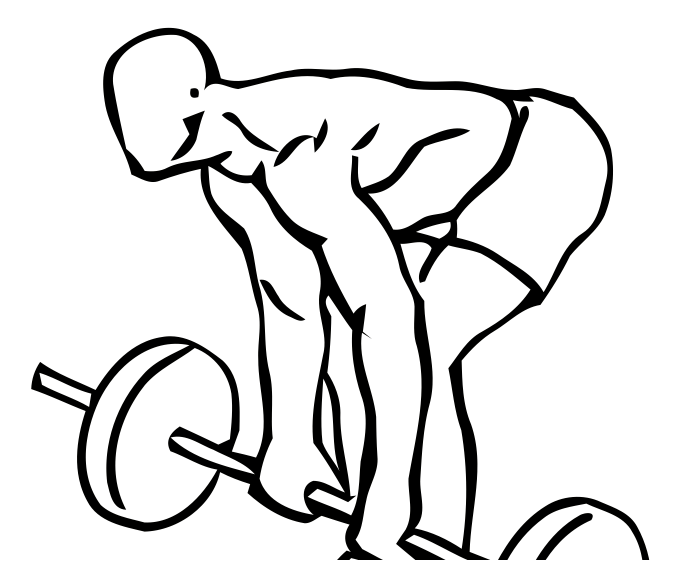
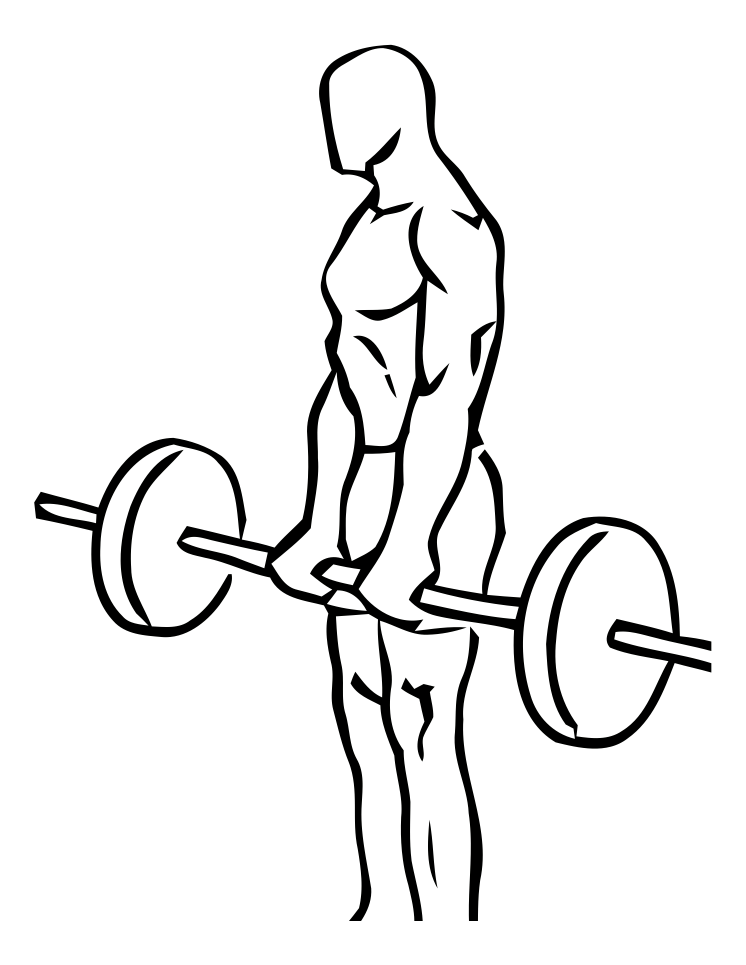
How to do the deadlift
- Stand with mid-foot under the bar and your feet hip-width apart.
- Bend at the hips and knees and hold the bar outside your legs, arms straight.
- Set your posture before you pull: a straight back, an open chest, and shoulders over the bar or a little in front of it.
- Push the floor with your feet and stand up with the bar close to your legs, until you are standing with the hips extended.
- Lower by sending the hips back first and keeping the bar close to your body until it rests on the floor.
At the top, just stand tall. There is no need to lean the torso back.
Common mistakes
- The back rounding at the start of the pull. If the spine curves to get the bar off the floor, the load is too heavy.
- The bar drifting away from the body. It should graze the shins and the thighs.
- The hips rising before the chest. Hips and chest rise together.
- Yanking the bar. Take the slack out of the arms before you pull, with no jerk.
Variations
Easier
A deadlift with a dumbbell or kettlebell between the feet, or with the bar starting on a higher support, so you do not have to go down as far.
Standard
Barbell deadlift, starting from the floor.
Harder
More load, always with the same technique, or a short pause just after the bar leaves the floor.
What the studies show
A systematic review of studies in trained people showed that, in the deadlift, the spinal erectors and the quadriceps show up as more active than the glutes and the hamstrings (Martín-Fuentes and colleagues, 2020).
Another review placed the conventional deadlift among the exercises with very high gluteus maximus activation, above 60% of a maximal contraction (Neto and colleagues, 2020).
Sets to start with
For beginners, the American College of Sports Medicine position stand suggests a load that allows 8 to 12 reps, 2 to 3 times a week. When you can do 1 or 2 more reps than planned, increase the load a little: the document talks about 2% to 10% (ACSM, 2009).
In practice, 2 to 3 sets with 1 to 2 minutes of rest are a good starting point. That number of sets is a practical suggestion, not a rule.
Who should be careful
Anyone with lower-back pain, a herniated disc, recent spinal surgery, uncontrolled high blood pressure or a heart problem should have clearance from a doctor and, preferably, guidance from a certified trainer or physical therapist before starting. Pain that radiates down the leg, or sharp back pain, is a reason to stop.
Informational text. It doesn’t replace an assessment by a certified trainer, physical therapist or doctor.
Read also
- Squat: how to do it right, common mistakes and variations
- Glute bridge: how to do it at home and progress to the hip thrust
- Training: exercises, home gear and books
Where to go next
Heavy deadlifts ask for recovery. Sleep, food and a simple progression plan are in building muscle. If you are just getting started, read starting at the gym.
References
- Martín-Fuentes I et al. Electromyographic activity in deadlift exercise and its variants. A systematic review. PLoS One. 2020;15(2):e0229507. https://pubmed.ncbi.nlm.nih.gov/32107499/
- Neto WK et al. Gluteus Maximus Activation during Common Strength and Hypertrophy Exercises: A Systematic Review. J Sports Sci Med. 2020;19(1):195-203. https://pubmed.ncbi.nlm.nih.gov/32132843/
- American College of Sports Medicine. American College of Sports Medicine position stand. Progression models in resistance training for healthy adults. Med Sci Sports Exerc. 2009;41(3):687-708. https://pubmed.ncbi.nlm.nih.gov/19204579/
Image credits
- Everkinetic 0099 (barbell-dead-lifts) illustration, by Greg Priday / Everkinetic project — https://github.com/everkinetic/data — CC BY-SA 4.0. Used without changes.