
The lat pulldown, also called the front pulldown, is the most common back exercise for people who cannot do a pull-up yet. You sit at the machine and pull the bar from above down to near the chest.
Because you can choose the load, it works both to get started and to train heavy. The most common question is about the grip, and the research helps answer it.
Quick summary
- Muscles: back (latissimus dorsi), with help from the biceps and the mid-back
- Level: beginner
- Equipment: a pulldown machine (high cable) with a bar
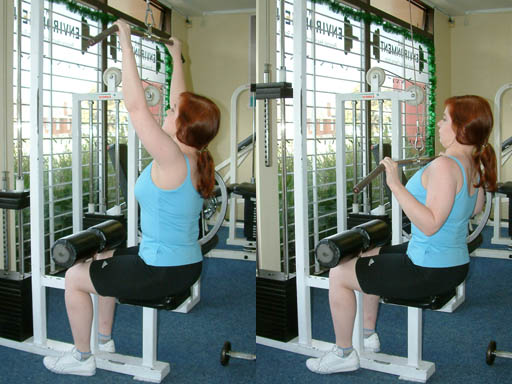

How to do the lat pulldown
- Adjust the thigh pad so your thighs are held in place, and sit with your feet on the floor.
- Hold the bar with your palms facing away, a little wider than your shoulders.
- With your chest open, pull the bar to the upper chest, driving your elbows down and back.
- Return slowly until your arms are straight.
Pull in front of your face, which is the version used in the studies cited below.
Common mistakes
- Leaning the torso back for help. A slight lean is normal. Lying back and using momentum is not.
- Letting the bar go at the top. The return is controlled, without letting the stack slam.
- Shrugging the shoulders. Think about taking the shoulders down, away from the ears, before you pull.
- A grip that is too wide. It does not help the lats and usually reduces the load you can use.
Variations
Easier
Less load and more control. Another option is to pull with a band anchored overhead.
Standard
Front lat pulldown, palms facing away, a medium grip.
Harder
Pull-ups, first with help (a band or an assisted machine) and then with just your bodyweight.
What the studies show
In a study with 12 men, the overhand grip (palms facing away) activated the latissimus dorsi more than the underhand grip, both wide and close (Lusk and colleagues, 2010).
Another study tested grips from 1 to 2 times shoulder width. Lat activation was similar across them, and the maximum load with the wide grip was a little lower than with the medium or close grip (Andersen and colleagues, 2014). In practice, a medium grip will do.
Sets to start with
For beginners, the American College of Sports Medicine position stand suggests a load that allows 8 to 12 reps, 2 to 3 times a week. When you can do 1 or 2 more reps than planned, increase the load a little: the document talks about 2% to 10% (ACSM, 2009).
In practice, 2 to 3 sets with 1 to 2 minutes of rest are a good starting point. That number of sets is a practical suggestion, not a rule.
Who should be careful
Shoulder pain when pulling, especially with the arms overhead, calls for an assessment by a physical therapist before you push through it. Anyone with a recent shoulder or elbow injury should come back with guidance. Sharp pain is a signal to stop.
Informational text. It doesn’t replace an assessment by a certified trainer, physical therapist or doctor.
Read also
- Push-up: how to do it, adapt it and progress
- Plank: how long to hold it and how to do it
- Training: exercises, home gear and books
Where to go next
To put the rest of the workout together in the first months, start with starting at the gym. If the goal is to gain muscle, see what actually works.
References
- Lusk SJ et al. Grip width and forearm orientation effects on muscle activity during the lat pull-down. J Strength Cond Res. 2010;24(7):1895-900. https://pubmed.ncbi.nlm.nih.gov/20543740/
- Andersen V et al. Effects of grip width on muscle strength and activation in the lat pull-down. J Strength Cond Res. 2014;28(4):1135-42. https://pubmed.ncbi.nlm.nih.gov/24662157/
- American College of Sports Medicine. American College of Sports Medicine position stand. Progression models in resistance training for healthy adults. Med Sci Sports Exerc. 2009;41(3):687-708. https://pubmed.ncbi.nlm.nih.gov/19204579/
Image credits
- “PulldownMachineExercise.JPG”, by GeorgeStepanek — https://commons.wikimedia.org/wiki/File:PulldownMachineExercise.JPG — CC BY-SA 3.0. Used without changes.