
In the shoulder press you push the dumbbells from shoulder height to above your head. It is the main overhead pressing exercise and it works the whole shoulder.
You can do it seated, with your back supported, or standing. Both versions work, and each has an advantage.
Quick summary
- Muscles: shoulders (deltoid), with help from the triceps
- Level: beginner to intermediate
- Equipment: a pair of dumbbells and a bench with a backrest
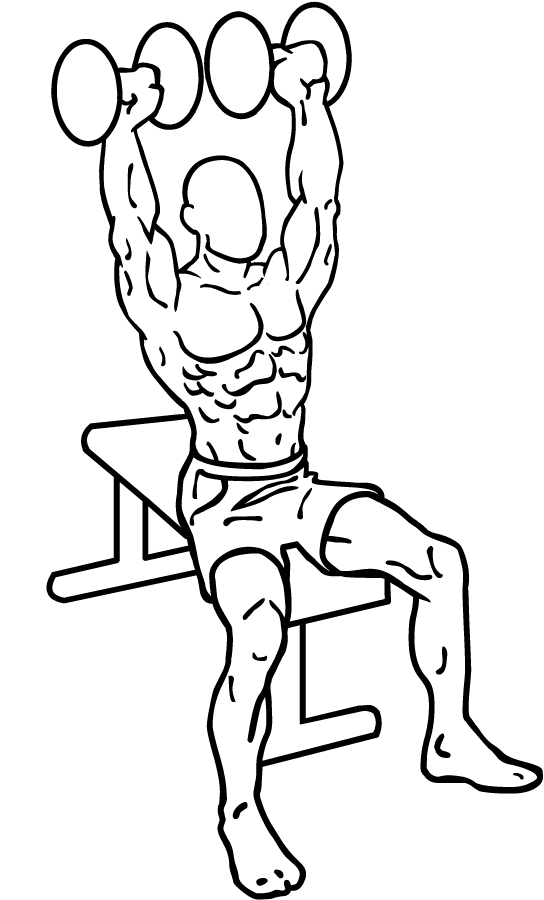
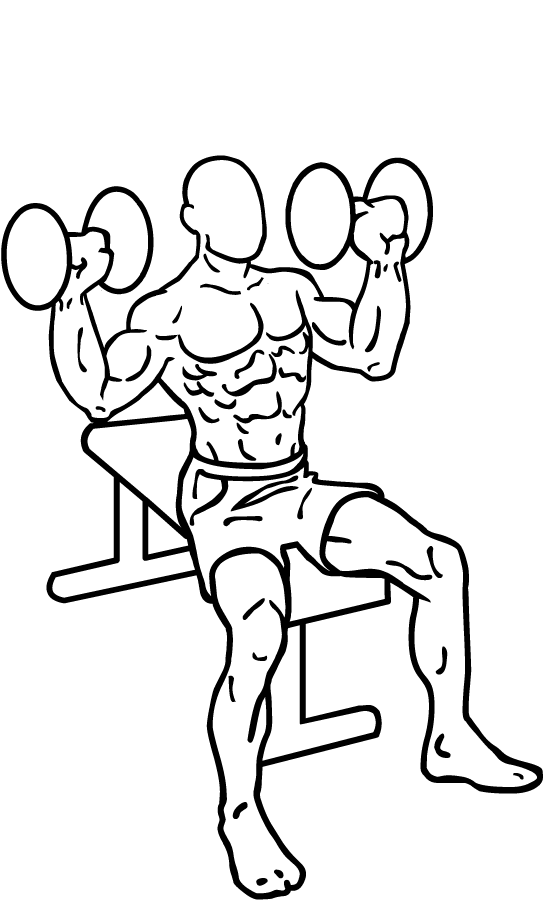

How to do the dumbbell shoulder press
- Sit on a bench with a backrest, feet planted on the floor, a dumbbell in each hand.
- Bring the dumbbells to shoulder height, palms facing forward and elbows under the wrists.
- Press the dumbbells up until your arms are almost straight.
- Lower under control until the dumbbells are back near ear height.
Common mistakes
- Arching the lower back too much. Your back stays against the backrest. If the lower back comes off, the load is too heavy.
- Elbows outside the line of the wrists. They stay under the wrists.
- Lowering only a little. Lower until the dumbbells are near ear height, if the shoulder allows it.
- The dumbbells clanking at the top. Stop before they touch.
Variations
Easier
One arm at a time, or lighter dumbbells.
Standard
Seated shoulder press, with your back supported.
Harder
Standing shoulder press, which asks for more full-body balance.
What the studies show
A study with 15 healthy men compared the shoulder press seated and standing, with a barbell and with dumbbells. Standing with dumbbells activated the shoulder the most, but it was also the version in which they lifted the least weight. Seated with dumbbells, they lifted about 10% more (Saeterbakken and Fimland, 2013). Seated gives more support and more load; standing asks for more stability.
Sets to start with
For beginners, the American College of Sports Medicine position stand suggests a load that allows 8 to 12 reps, 2 to 3 times a week. When you can do 1 or 2 more reps than planned, increase the load a little: the document talks about 2% to 10% (ACSM, 2009).
In practice, 2 to 3 sets with 1 to 2 minutes of rest are a good starting point. That number of sets is a practical suggestion, not a rule.
Who should be careful
Anyone who feels shoulder pain with the arm overhead should see a physical therapist before pushing through it. Uncontrolled high blood pressure and heart problems call for medical clearance before heavy strength training. Sharp pain is a signal to stop.
Informational text. It doesn’t replace an assessment by a certified trainer, physical therapist or doctor.
Read also
- Push-up: how to do it, adapt it and progress
- Plank: how long to hold it and how to do it
- Training: exercises, home gear and books
Where to go next
To put the rest of the workout together in the first months, see starting at the gym. If the goal is to gain muscle, read building muscle.
References
- Saeterbakken AH et al. Effects of body position and loading modality on muscle activity and strength in shoulder presses. J Strength Cond Res. 2013;27(7):1824-31. https://pubmed.ncbi.nlm.nih.gov/23096062/
- American College of Sports Medicine. American College of Sports Medicine position stand. Progression models in resistance training for healthy adults. Med Sci Sports Exerc. 2009;41(3):687-708. https://pubmed.ncbi.nlm.nih.gov/19204579/
Image credits
- “Dumbbell-shoulder-press-1.png”, by Everkinetic — https://commons.wikimedia.org/wiki/File:Dumbbell-shoulder-press-1.png — CC BY-SA 3.0. Used without changes.
- “Dumbbell-shoulder-press-2.png”, by Everkinetic — https://commons.wikimedia.org/wiki/File:Dumbbell-shoulder-press-2.png — CC BY-SA 3.0. Used without changes.
