
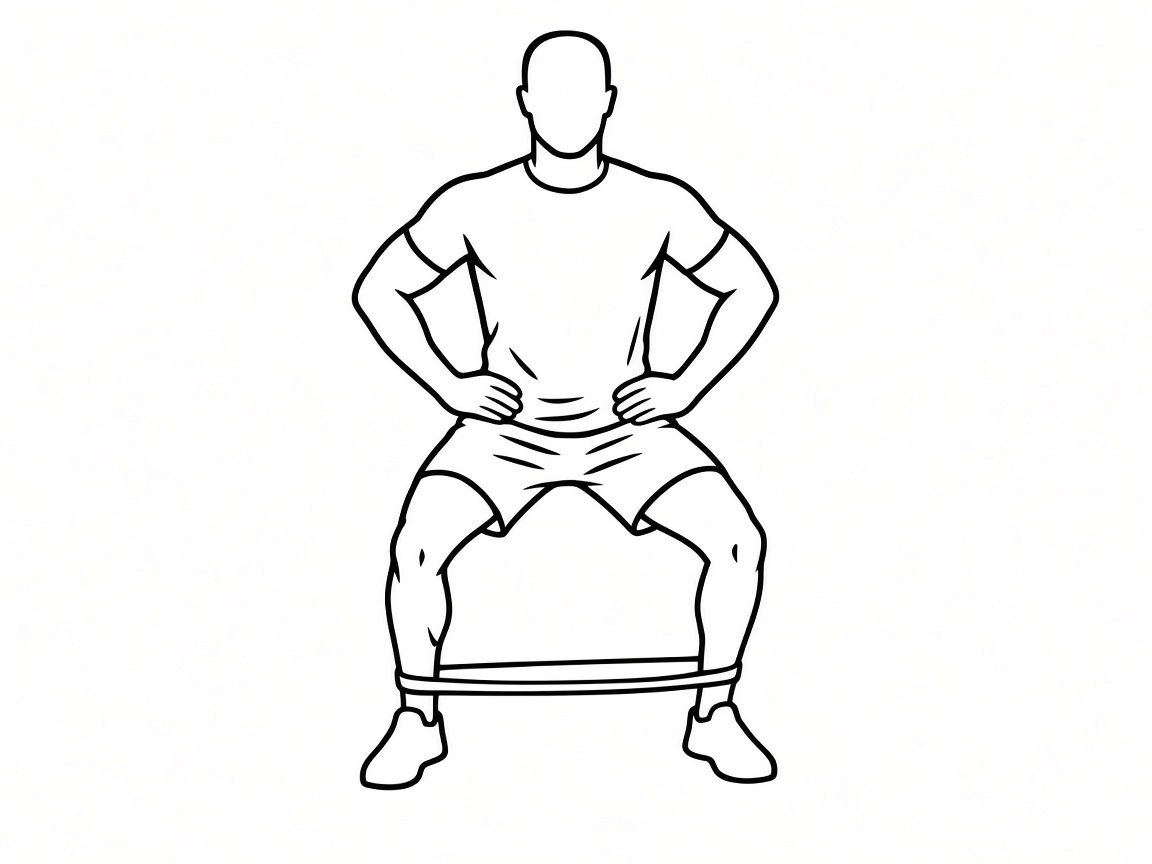
The lateral walk is stepping sideways with a band around the legs, without letting it go slack. It works the side of the hip, where the gluteus medius sits.
It is light, fits in a living room, and usually shows up as a warm-up or as a complement to a leg workout. Where you place the band makes a difference.
Quick summary
- Muscles: gluteus medius and gluteus maximus (side of the hip)
- Level: beginner
- Equipment: a mini band (a looped resistance band)
How to do the lateral band walk
- Place the mini band around the front of the feet or around the ankles.
- Stand with your feet hip-width apart and bend your knees and hips a little, as in a quarter squat.
- Take a step to the side, keeping the band stretched.
- Bring the other foot in, without letting your feet touch.
- Take the steps one way, then come back the other way.
Common mistakes
- Standing up straight. The quarter squat makes the glute work more.
- Letting the band go slack. Your feet should not touch in the middle of the step.
- The torso swaying from side to side. The torso stays still. The legs are what move.
- Knees caving in. They should point in the same direction as the feet.
Variations
Easier
Band above the knees, which makes it lighter, and short steps.
Standard
Band around the ankles, in a quarter squat.
Harder
Band around the front of the feet, or a stronger band.
Affiliate disclosure: This article contains affiliate links (sponsored) to Amazon.com.br, a Brazilian store: prices are in Brazilian reais (BRL) and products ship only within Brazil. If you buy through these links, Xalau may earn a commission at no extra cost to you. This doesn’t change our analysis or the price. Details in our affiliate policy.
If you do not have a band yet, an Acte mini-band kit comes with different tensions so you can progress.
Sponsored link · Amazon.com.br (Brazil) · learn more
Acte mini band kit
Bands with different tensions for glutes and hips.
See price on Amazon.com.brWhat the studies show
In a study with 22 healthy adults, the gluteus maximus and the gluteus medius worked more when the band moved from the knees to the ankles, and still more when it went to the feet (Lewis and colleagues, 2018).
Another study, with 24 adults, showed that walking in a quarter squat increased glute work and reduced work from the tensor fasciae latae, a muscle on the side of the thigh, compared with walking fully upright (Berry and colleagues, 2015).
To put the size of the effect in context: in a third study, the lateral walk activated the gluteus maximus much less than the squat and the single-leg deadlift (Distefano and colleagues, 2009). It is a good complement and does not replace the main leg exercises.
Sets to start with
For beginners, the American College of Sports Medicine position stand suggests a load that allows 8 to 12 reps, 2 to 3 times a week. When you can do 1 or 2 more reps than planned, increase the load a little: the document talks about 2% to 10% (ACSM, 2009).
In practice, 2 to 3 sets with 1 to 2 minutes of rest are a good starting point. That number of sets is a practical suggestion, not a rule.
Who should be careful
Anyone with hip or knee pain, or a recent injury, should start with a lighter band and, if the pain continues, see a physical therapist. Check that the band is not torn before you use it. Sharp pain is a signal to stop.
Informational text. It doesn’t replace an assessment by a certified trainer, physical therapist or doctor.
Read also
- Glute bridge: how to do it at home and progress to the hip thrust
- Squat: how to do it right, common mistakes and variations
- Lunge: how to do stationary, reverse and walking lunges
- Training: exercises, home gear and books
Where to go next
Glutes grow with a load that increases little by little, protein and sleep. The rest is in building muscle.
References
- Lewis CL et al. Hip-Muscle Activity in Men and Women During Resisted Side Stepping With Different Band Positions. J Athl Train. 2018;53(11):1071-1081. https://pubmed.ncbi.nlm.nih.gov/30615490/
- Berry JW et al. Resisted Side Stepping: The Effect of Posture on Hip Abductor Muscle Activation. J Orthop Sports Phys Ther. 2015;45(9):675-82. https://pubmed.ncbi.nlm.nih.gov/26161629/
- Distefano LJ et al. Gluteal muscle activation during common therapeutic exercises. J Orthop Sports Phys Ther. 2009;39(7):532-40. https://pubmed.ncbi.nlm.nih.gov/19574661/
- American College of Sports Medicine. American College of Sports Medicine position stand. Progression models in resistance training for healthy adults. Med Sci Sports Exerc. 2009;41(3):687-708. https://pubmed.ncbi.nlm.nih.gov/19204579/