
The calf raise is standing up on your toes and lowering slowly. It doesn’t look like much, but done through a full range and under control it tires you out fast.
You can do it on the living-room floor, on a stair step, or holding dumbbells. The standing version has an edge, as the research below shows.
Quick summary
- Muscles: calves (gastrocnemius and soleus)
- Level: beginner
- Equipment: none (a step and dumbbells in the harder versions)
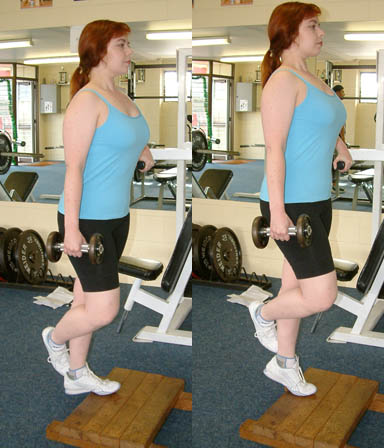

How to do the standing calf raise
- Stand with your feet hip-width apart. If you need to, rest your hands on a wall.
- Rise onto your toes, lifting your heels as high as you can.
- Hold for a second at the top.
- Lower slowly until the heel is back on the floor.
On a step, rest only the front of the foot and let the heel drop a little below the edge of the step.
Common mistakes
- Bouncing up and down. Go slowly, with a pause at the top.
- A short range of motion. Rise as high as you can and lower all the way.
- The foot turning out. The weight stays on the front of the foot, near the big toe.
- The knee bending. In the standing version, the knee stays straight.
Variations
Easier
On the floor, with both hands on the wall.
Standard
On a step, with one hand for support.
Harder
One leg at a time on the step, or holding dumbbells, as in the photo.
What the studies show
In a 12-week study with 14 untrained adults, each person trained one leg with a standing calf raise, knee straight, and the other seated, knee bent. The leg trained standing gained much more volume in the gastrocnemius, the larger part of the calf. The soleus grew in a similar way in both (Kinoshita and colleagues, 2023).
Sets to start with
For beginners, the American College of Sports Medicine position stand suggests 8 to 12 reps per set, 2 to 3 times a week (ACSM, 2009). With bodyweight work, when it gets easy, move to a harder variation instead of just piling on endless reps.
In practice, 2 to 3 sets with 1 to 2 minutes of rest are a good starting point. That number of sets is a practical suggestion, not a rule.
Who should be careful
Anyone with Achilles tendon pain, pain in the sole of the foot, or a recent ankle injury should talk to a physical therapist before starting, especially in the step version. Sharp pain is a signal to stop.
Informational text. It doesn’t replace an assessment by a certified trainer, physical therapist or doctor.
Read also
- Squat: how to do it right, common mistakes and variations
- Jumping jacks: how to do them and the low-impact version
- Lunge: how to do stationary, reverse and walking lunges
- Training: exercises, home gear and books
Where to go next
Consistency counts more than any trick. For the rest of the workout, see building muscle.
References
- Kinoshita M et al. Triceps surae muscle hypertrophy is greater after standing versus seated calf-raise training. Front Physiol. 2023;14:1272106. https://pubmed.ncbi.nlm.nih.gov/38156065/
- American College of Sports Medicine. American College of Sports Medicine position stand. Progression models in resistance training for healthy adults. Med Sci Sports Exerc. 2009;41(3):687-708. https://pubmed.ncbi.nlm.nih.gov/19204579/
Image credits
- “DumbbellStandingCalfRaise.JPG”, by GeorgeStepanek — https://commons.wikimedia.org/wiki/File:DumbbellStandingCalfRaise.JPG — CC BY-SA 3.0. Used without changes.