
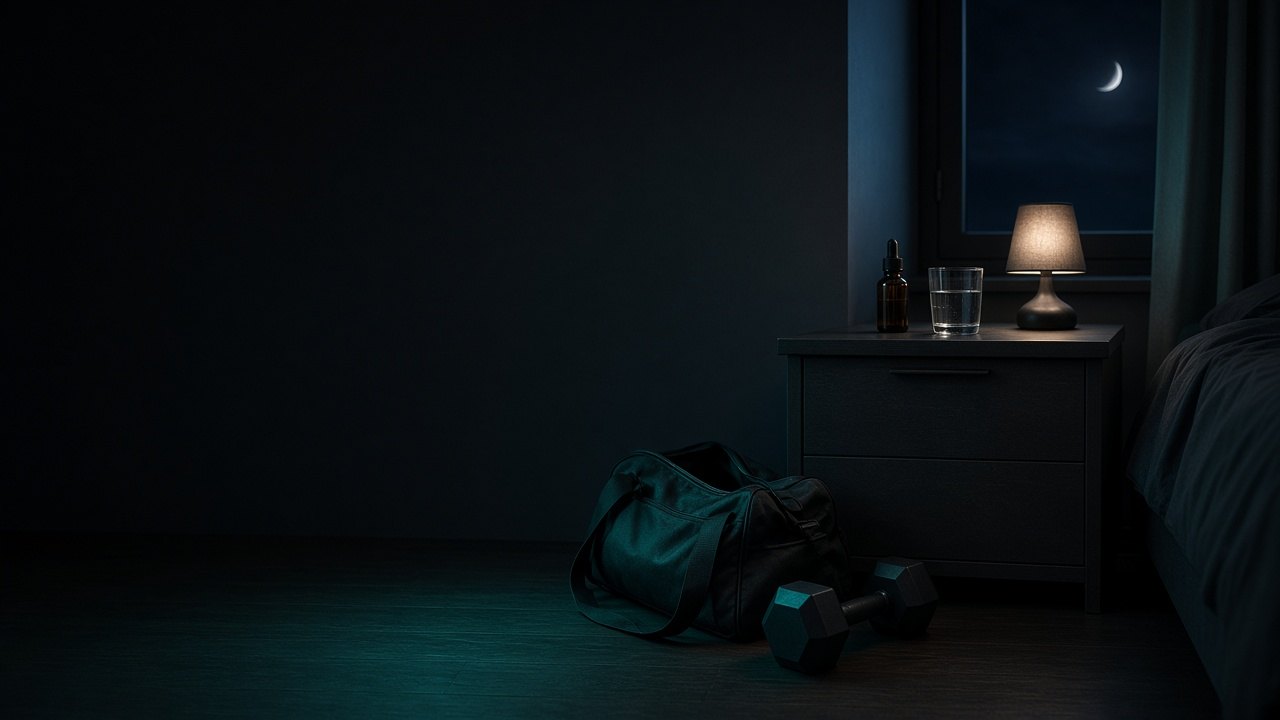
Melatonin is a hormone your body makes when it gets dark. It tells your system that it is time to sleep. Bright light at night, especially from screens, delays it.
As a supplement, it has become popular among people who train and sleep badly. But the average effect in studies is small: a few minutes less to fall asleep. For people who train, sleep habits usually make a much bigger difference than any capsule.
Not medical advice. Insomnia that lasts for weeks, loud snoring, pauses in breathing or sleep that does not feel restful need a proper check. Children and pregnant or breastfeeding women should not use it. If you have epilepsy, asthma, an inflammatory or autoimmune condition or a mood disorder, take medication, or drive and operate machinery, talk to your doctor first.
Do: Fixed bed and wake times, a dark bedroom and less screen time before bed.
Avoid: Using melatonin to cover up insomnia without looking for the cause.
Quick facts
Effect
On average, about 7 minutes less to fall asleep and 8 minutes more sleep, according to a meta-analysis of people with sleep disorders.
Rules vary by country
In Brazil, the health agency (Anvisa) allows melatonin supplements for adults (19 and older) at up to 0.21 mg a day, with no sleep claims on the label. In other countries, it is sold at much higher doses or only by prescription.
Safety
Short term, it is usually well tolerated. Most reported side effects: sleepiness, headache and dizziness.
What the science says
Effect on sleep. The meta-analysis by Ferracioli-Oda and colleagues (2013) pooled 19 studies with 1,683 people with primary sleep disorders. Melatonin cut the time to fall asleep by about 7 minutes and added about 8 minutes of total sleep. Limitation: small effect, and the studies used doses higher than Brazil’s supplement limit.
Medical guideline. The American Academy of Sleep Medicine (Sateia and colleagues, 2017) suggests not using melatonin to treat chronic insomnia in adults. The recommendation is weak and the evidence quality is low.
The label does not always match. Erland and Saxena (2017) tested 31 melatonin supplements. The actual amount ranged from 83% less to 478% more than the label stated.
Safety. The review by Besag and colleagues (2019), covering 37 trials, found few side effects, generally mild to moderate — the most common were daytime sleepiness, headache and dizziness. Limitation: almost all trials lasted 4 weeks or less.
Sleep and performance. Mah and colleagues (2011) asked college basketball players to aim for 10 hours in bed per night for 5 to 7 weeks. Sprint times and shooting improved. Limitation: 11 athletes, no separate control group. Still, it shows how much sleep matters — and that came from sleeping more, with no supplement.
What to do in practice
- Start with your routine. Same bed and wake times, weekends included.
- Cut bright light at night. Dim screens and white light in the last hour before bed.
- Watch late caffeine. Caffeine and pre-workout in the evening disrupt sleep for many people.
- Dark, quiet, cool bedroom. It sounds basic, but it is what works best.
- If you use melatonin, follow local rules. Low doses and short periods; anything beyond that is a conversation with your doctor.
- Drops under the tongue: Brazil’s health agency says sublingual melatonin is not authorized there; check the rules where you live.
- Is it bad to take every day? In studies lasting up to a few weeks, side effects were mild. For daily use over months or years, data is lacking — so do not take it without a reason or without talking to your doctor.
- Persistent insomnia needs a visit. See a doctor to find the cause.
| Habit | What to do |
|---|---|
| Schedule | Same bed and wake times |
| Light | Less screen time and bright light in the last hour |
| Caffeine | Avoid in the late afternoon and evening |
| Training | Very late workouts can delay sleep for some people |
Affiliate disclosure: This article contains affiliate links (sponsored) to Amazon.com.br, a Brazilian store: prices are in Brazilian reais (BRL) and products ship only within Brazil. If you buy through these links, Xalau. may earn a commission at no extra cost to you. This doesn’t change our analysis or the price. Details in our affiliate policy.
Read next: caffeine and pre-workout: how much and when, magnesium for people who train (and what science says about sleep) and muscle gain: what actually works.

Sponsored link · Amazon.com.br (Brazil) · learn more
Lavitan Melatonin 0.21 mg — 90 chewable tablets
Check the label and the product page.
See price on Amazon.com.brSummary
- Melatonin has a small average effect: a few extra minutes of sleep
- Rules vary: in Brazil, supplements are for adults only, up to 0.21 mg a day, with no sleep claims
- The real amount in products can vary a lot
- Sleep routine and less light at night matter more than the capsule
- Insomnia that does not go away: see a doctor
Tip: before buying anything for sleep, try one week with fixed times and no screens in the last hour. Write down how you feel when you wake up.
Not sure what makes sense for you? Take the quiz Which supplement fits your goal? (in Portuguese) — it takes 1 minute and promises no miracles.
References
- Ferracioli-Oda E et al. Meta-analysis: melatonin for the treatment of primary sleep disorders. PLoS One. 2013;8(5):e63773. https://pubmed.ncbi.nlm.nih.gov/23691095/
- Sateia MJ et al. Clinical practice guideline for the pharmacologic treatment of chronic insomnia in adults: an American Academy of Sleep Medicine clinical practice guideline. J Clin Sleep Med. 2017;13(2):307-349. https://pubmed.ncbi.nlm.nih.gov/27998379/
- Erland LA, Saxena PK. Melatonin natural health products and supplements: presence of serotonin and significant variability of melatonin content. J Clin Sleep Med. 2017;13(2):275-281. https://pubmed.ncbi.nlm.nih.gov/27855744/
- Besag FMC et al. Adverse events associated with melatonin for the treatment of primary or secondary sleep disorders: a systematic review. CNS Drugs. 2019;33(12):1167-1186. https://pubmed.ncbi.nlm.nih.gov/31722088/
- Mah CD et al. The effects of sleep extension on the athletic performance of collegiate basketball players. Sleep. 2011;34(7):943-50. https://pubmed.ncbi.nlm.nih.gov/21731144/
- Anvisa (Brazil). Anvisa autoriza melatonina na forma de suplemento alimentar. 2021. https://www.gov.br/anvisa/pt-br/assuntos/noticias-anvisa/2021/anvisa-autoriza-a-melatonina-na-forma-de-suplemento-alimentar
- Anvisa (Brazil). Uso de melatonina sublingual não é autorizado no Brasil. https://www.gov.br/anvisa/pt-br/assuntos/noticias-anvisa/uso-de-melatonina-sublingual-nao-e-autorizado-no-brasil