
In the plank you hold still, resting on your forearms and the balls of your feet, with your body straight. It looks easy until the clock passes 30 seconds. The work is done by your abs, which hold your spine so it doesn’t sag.
Two things are worth making clear right away. Planks don’t burn belly fat: they strengthen your core, which helps in other exercises and in daily life. And you don’t need to set records. Holding for several minutes while your posture falls apart is worth less than 20 to 40 well-done seconds.
The fat part has a study behind it: six weeks of abdominal exercises, five times a week and with no change in diet, didn’t reduce belly fat or waist circumference. What improved was abdominal endurance (Vispute and colleagues, 2011).
Quick summary
- Muscles: abs (rectus and transverse) and obliques; shoulders and glutes help
- Level: beginner
- Equipment: none (an exercise mat makes it more comfortable)


How to do a plank
- Rest your forearms on the floor, with your elbows right under your shoulders.
- Stretch your legs back and rest on the balls of your feet, hip-width apart.
- Squeeze your glutes and draw your belly button in slightly, without holding your breath.
- Keep your body in line from head to heels. Look at the floor, a little in front of your hands.
- Hold for the planned time, breathing short and calm. When your hips start to drop, the set is over.
Common mistakes
- Hips dropping and lower back sagging. It’s the most common mistake and the one that bothers the back most.
- Hips too high, with your body shaped like a mountain. It gets easier and your abs work less.
- Shoulders hunched up near your ears. Push the floor away with your forearms.
- Holding your breath. Besides tiring you faster, it raises your blood pressure.
- Insisting on the time after your posture is already gone.
Variations
Easier
Plank with your knees on the floor, or incline, with your forearms on a bench or the couch seat.
Standard
Forearm plank, as in the step-by-step.
Affiliate disclosure: This article contains affiliate links (sponsored) to Amazon.com.br, a Brazilian store: prices are in Brazilian reais (BRL) and products ship only within Brazil. If you buy through these links, Xalau. may earn a commission at no extra cost to you. This doesn’t change our analysis or the price. Details in our affiliate policy.
If the floor is hard, a high-density exercise mat (Muvin, a Brazilian brand) spares your elbows.
Harder
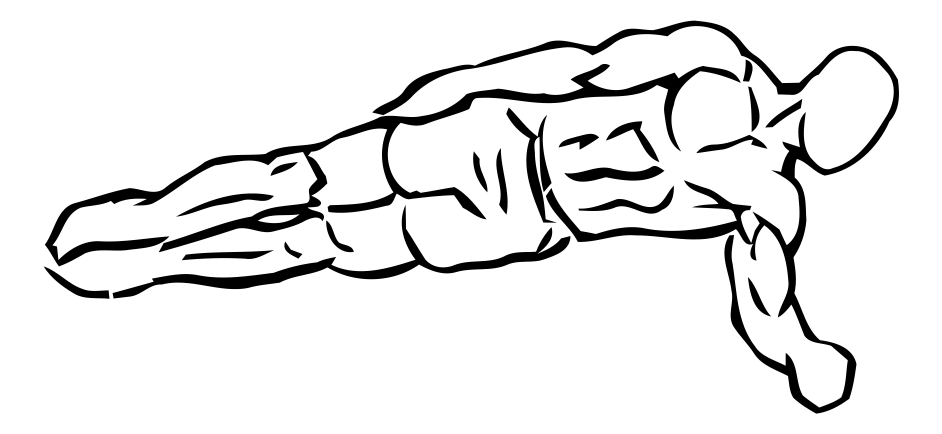
Side plank (below), lifting one foot or one arm off the floor, or a straight-arm plank, bringing one hand to the opposite shoulder without rotating your hips.
Another option tested in a study: place your elbows further forward, away from the line of your shoulders, and tuck your pelvis, as if pressing your belly button toward your spine. This version activated the abs and external obliques much more than the regular plank (Schoenfeld and colleagues, 2014). The side plank, in turn, works the gluteus medius and external obliques at a level that serves for gaining strength, while the front plank stayed more in the endurance and stability range (Ekstrom and colleagues, 2007).

Sponsored link · Amazon.com.br (Brazil) · learn more
Muvin high-density exercise mat
For planks, crunches and stretching on the floor.
See price on Amazon.com.brSets to start with
Do 3 sets of 15 to 40 seconds, with 30 to 60 seconds of rest, 2 to 4 times a week. Add 5 seconds when the last set feels solid. Easily past 60 seconds? It’s better to move to a harder variation than to hold still longer, because the variation is what increases the work of the abs (Schoenfeld and colleagues, 2014).
Who should be careful
If you have lower-back pain, a herniated disc or shoulder pain, talk to a physical therapist first. If you have high blood pressure, be careful not to hold your breath. Pregnant women and people in the postpartum period, especially with diastasis recti, should get professional guidance, because the regular plank isn’t always the best choice in that phase.
Informational text. It doesn’t replace an assessment by a certified trainer, physical therapist or doctor.
Read also
- Push-up: how to do it, adapt it and progress
- Burpee: how to do it and the no-jump version
- Glute bridge: how to do it at home and progress
- Squat: how to do it right, common mistakes and variations
Where to go next
The plank doesn’t burn belly fat, no matter how much the internet insists. For that, the path is a calorie deficit, protein and strength training. If you’re still putting your routine together, Starting at the gym helps you organize the first months.
References
- Vispute SS et al. The effect of abdominal exercise on abdominal fat. J Strength Cond Res. 2011;25(9):2559-64. https://pubmed.ncbi.nlm.nih.gov/21804427/
- Ekstrom RA, Donatelli RA, Carp KC. Electromyographic analysis of core trunk, hip, and thigh muscles during 9 rehabilitation exercises. J Orthop Sports Phys Ther. 2007;37(12):754-62. https://pubmed.ncbi.nlm.nih.gov/18560185/
- Schoenfeld BJ et al. An electromyographic comparison of a modified version of the plank with a long lever and posterior tilt versus the traditional plank exercise. Sports Biomech. 2014;13(3):296-306. https://pubmed.ncbi.nlm.nih.gov/25325773/
Image credits
- “Plank exercise.svg” by Pk0001 — https://commons.wikimedia.org/wiki/File:Plank_exercise.svg — CC BY-SA 4.0. Converted from SVG to PNG, with no other changes.
- Everkinetic illustration 0113 (side plank), by Greg Priday / Everkinetic project — https://github.com/everkinetic/data — CC BY-SA 4.0. Used without changes.
The featured image for this post was produced for Xalau.