

The squat is the motion of sitting down and standing up, just done with attention. If you get up from the couch without using your hands, you already do a version of it. Training this movement makes your thighs and glutes stronger and makes very everyday things easier, like climbing stairs or picking a box up off the floor.
It’s also the most searched-for leg exercise in Brazil, and for good reason: you can do it anywhere, with no equipment, and it grows with you. When body weight gets easy, just hold a dumbbell.
The quadriceps, at the front of the thigh, does the bulk of the work. The glutes, hamstrings and calves also pitch in (Escamilla, 2001; Contreras and colleagues, 2015).
Quick summary
- Muscles: quadriceps and glutes; hamstrings, calves and abs help
- Level: beginner
- Equipment: none (a dumbbell or kettlebell for the harder versions)


How to do a squat
- Stand with your feet a little wider than your hips and your toes turned slightly out.
- Breathe in and brace your belly, as if someone were about to give you a light push. Extend your arms in front of you to help with balance.
- Move your hips back and down at the same time, as if sitting in a chair a little behind you.
- Go down as far as you can while keeping your heels on the floor and your back from rounding. For most people, that’s with the thighs near knee level.
- Push the floor away with your whole foot and come up breathing out. Your knees follow the direction of your feet the whole time.
Common mistakes
- Knees caving in. Think about “spreading the floor” with your feet and let your knee point toward your second toe.
- Heels lifting off the floor. Widen your feet a little more, go down less, or put a thin wedge (a book, a weight plate) under your heels while you gain ankle mobility.
- Going down by bending only the knees. The hips go back too. A chair behind you helps you get the idea.
- Back rounding at the bottom. Stop a little earlier, at the point where your spine still stays firm.
- Rushing. Taking 2 to 3 seconds to go down already fixes a good part of the problems above.
And a myth worth clearing up: your knee going past your toes isn’t a mistake in itself. In people with long legs or loose ankles, it happens naturally. In a study with barbell squats, stopping the knee from moving forward took a little load off the knee, but shifted much more effort to the hips and lower back and made the torso lean more (Fry and colleagues, 2003). What matters is the knee lined up with the foot and the heel on the floor.
Variations
Easier
Chair squat: sit down lightly and stand up, without dropping into the seat. If your balance is poor, hold on to a door frame.
Standard
Bodyweight squat, as in the step-by-step above.
Harder
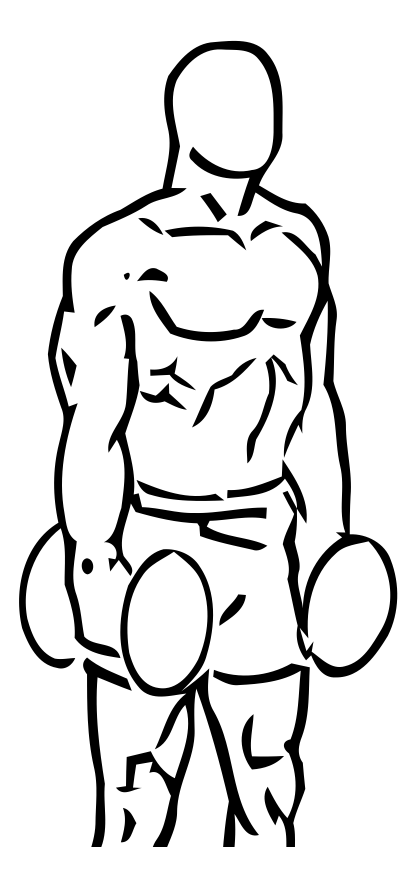
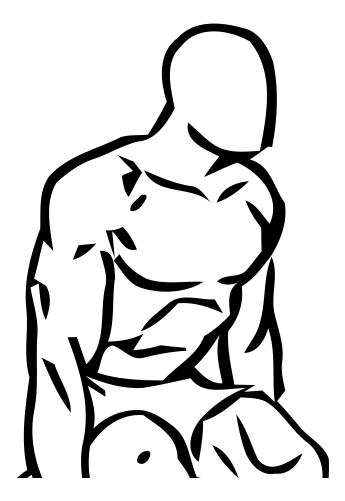
Goblet squat, holding a dumbbell or kettlebell against your chest. The weight in front helps keep your torso upright. You can also use two dumbbells at your sides, as in the illustration below.
Affiliate disclosure: This article contains affiliate links (sponsored) to Amazon.com.br, a Brazilian store: prices are in Brazilian reais (BRL) and products ship only within Brazil. If you buy through these links, Xalau. may earn a commission at no extra cost to you. This doesn’t change our analysis or the price. Details in our affiliate policy.
For training at home, a 5 kg (11 lb) rubber-coated dumbbell (Acte, a Brazilian brand) will carry the goblet squat for a good while. If that’s still heavy, start with a 2 kg (4.4 lb) one.
Sponsored link · Amazon.com.br (Brazil) · learn more
Acte rubber-coated dumbbell, 5 kg
To add load to squats at home.
See price on Amazon.com.brSponsored link · Amazon.com.br (Brazil) · learn more
Acte rubber-coated dumbbells, 2 kg
Light, for lunges, arms and shoulders.
See price on Amazon.com.brSets to start with
Do 2 to 3 sets of 8 to 12 reps, 2 or 3 times a week, with 1 to 2 minutes of rest. That’s the range the American College of Sports Medicine (ACSM) recommends for beginners, and 2 to 3 days a week is the recommended frequency for training the major muscle groups (ACSM, 2009; Garber and colleagues, 2011). Finish each set feeling you could still do 2 or 3 more. When you easily go past 12 in all three sets, it’s time to make it harder: the next variation, a slower descent or a dumbbell in your hands.
Who should be careful
If you have knee, hip or lower-back pain, had recent surgery, or are pregnant without professional follow-up, talk to a physical therapist or a certified trainer before you start. A burning feeling in the muscle is expected. Sharp pain, the stabbing or locking kind, is a sign to stop.
Informational text. It doesn’t replace an assessment by a certified trainer, physical therapist or doctor.
Read also
- Lunge: stationary, reverse and walking
- Glute bridge: how to do it at home and progress
- Push-up: how to do it, adapt it and progress
- Creatine: the no-nonsense guide
Where to go next
If your goal is to build muscle, the squat is only one part of the equation. Food, protein and load progression are in how to really build muscle. And if you’re still in your first months of training, it’s worth reading what to take (and what not to) when you’re starting at the gym first.
References
- Escamilla RF. Knee biomechanics of the dynamic squat exercise. Med Sci Sports Exerc. 2001;33(1):127-41. https://pubmed.ncbi.nlm.nih.gov/11194098/
- Contreras B et al. A Comparison of Gluteus Maximus, Biceps Femoris, and Vastus Lateralis Electromyographic Activity in the Back Squat and Barbell Hip Thrust Exercises. J Appl Biomech. 2015;31(6):452-8. https://pubmed.ncbi.nlm.nih.gov/26214739/
- Fry AC, Smith JC, Schilling BK. Effect of knee position on hip and knee torques during the barbell squat. J Strength Cond Res. 2003;17(4):629-33. https://pubmed.ncbi.nlm.nih.gov/14636100/
- American College of Sports Medicine. American College of Sports Medicine position stand. Progression models in resistance training for healthy adults. Med Sci Sports Exerc. 2009;41(3):687-708. https://pubmed.ncbi.nlm.nih.gov/19204579/
- Garber CE et al. American College of Sports Medicine position stand. Quantity and quality of exercise for developing and maintaining cardiorespiratory, musculoskeletal, and neuromotor fitness in apparently healthy adults: guidance for prescribing exercise. Med Sci Sports Exerc. 2011;43(7):1334-59. https://pubmed.ncbi.nlm.nih.gov/21694556/
Image credits
- “Squats.gif” by Wensceslao — https://commons.wikimedia.org/wiki/File:Squats.gif — CC BY-SA 4.0. Used without changes.
- Everkinetic illustration 0130 (squats using dumbbells), by Greg Priday / Everkinetic project — https://github.com/everkinetic/data — CC BY-SA 4.0. Used without changes.
The featured image for this post was produced for Xalau.